
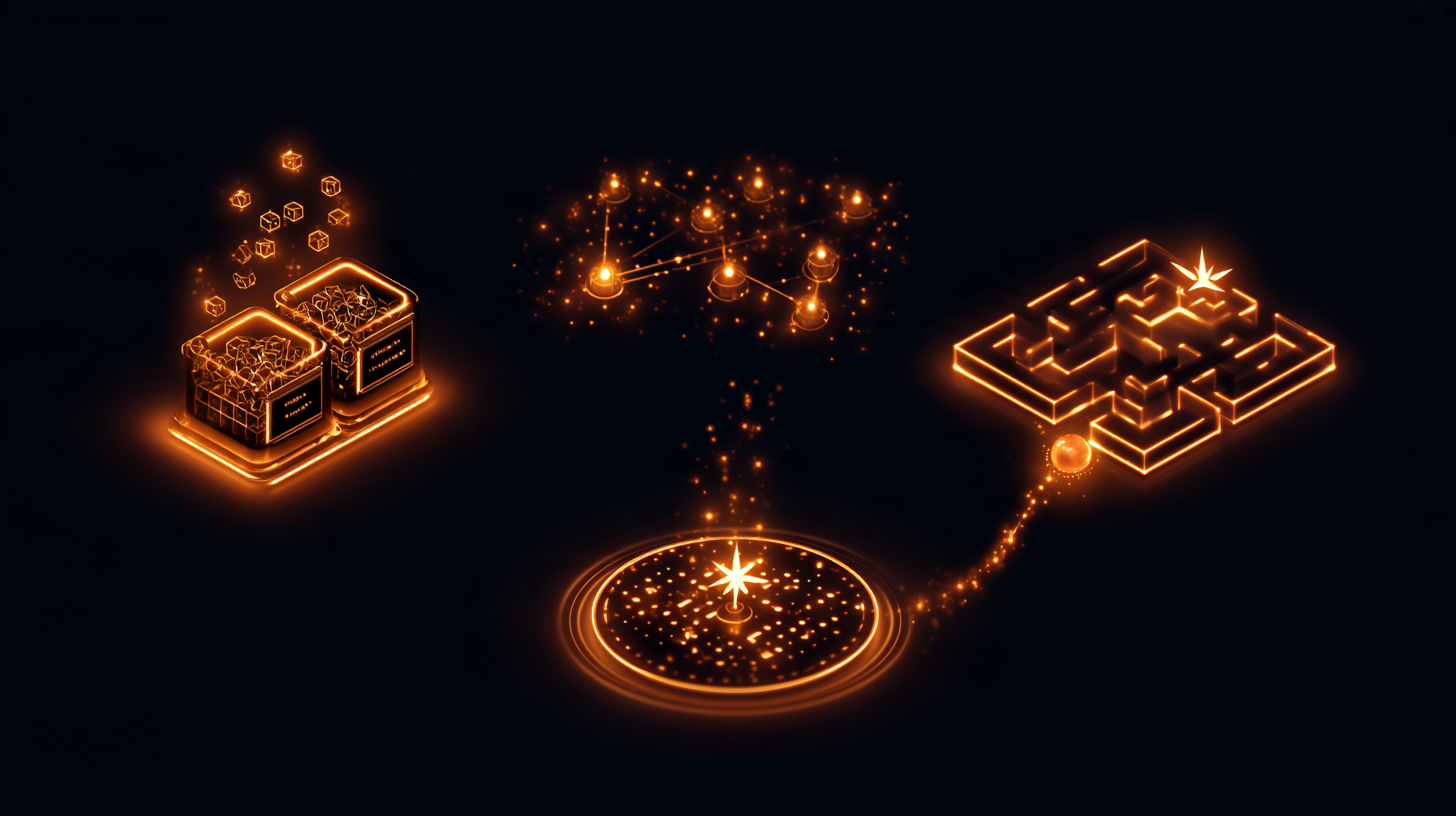
Nobody sat down and typed out the rules for how your email app spots spam. Nobody wrote a rule for how your phone finds faces in photos, either. The computer worked the rules out on its own, by studying a huge pile of examples.
That’s machine learning, and it’s the engine behind almost everything on the Periodic Table of AI. It has its own group on the chart, the orange tiles in the first column. There are six of them, and this post walks through each one.

If you missed the last post, Core Concepts covers the building blocks these methods run on, like neural networks and tokens.
The big idea
Machine Learning
Machine learning is a way of building software without writing out the rules. Instead of telling the computer what to do step by step, you show it a lot of examples and let it find the pattern.
Think about teaching a kid what a dog is. You don’t hand them a rulebook about ear shape and tail length. You point at dogs until they get it. Machine learning works the same way, just with millions of examples instead of a few.
The next three tiles are the three main ways that teaching can happen.
Three ways to teach a machine
Supervised Learning
In supervised learning, every example comes with the right answer attached. Photos labeled “cat” or “not cat.” Emails labeled “spam” or “not spam.” Houses listed with their sale prices.
The computer makes a guess, checks it against the answer, and adjusts. After enough rounds, it can guess well on examples it has never seen. It’s the most common kind of machine learning, and it’s the one behind spam filters and price predictions.
The catch is that someone has to label all those examples. That takes time and money.
Unsupervised Learning
Unsupervised learning skips the answer key. You hand the computer a pile of data and let it look for structure on its own.
A store might feed it thousands of shopping histories. Without being told anything, the computer sorts customers into groups of similar buyers. Nobody named the groups ahead of time. The computer found them, and a person decides what they mean.
It’s a good fit when you have lots of data and no labels, and you want to see what’s hiding in it.
Reinforcement Learning
Reinforcement learning works by trial and error. The computer tries something, gets a reward or a penalty, and gradually learns which choices pay off.
It’s how you’d train a dog with treats, only the computer can run millions of practice rounds. This approach is behind game-playing AI like AlphaGo, which beat a world champion at Go in 2016. It’s also a key piece of how chatbots get tuned to give better answers, which you’ll see when we get to RLHF in the Data & Training post.
Two ways to go further
Deep Learning
Deep learning is machine learning that uses neural networks with many layers stacked on top of each other. The “deep” just means lots of layers.
More layers let the network pick up more complicated patterns. The early layers might notice edges in a photo, the middle layers might spot eyes and ears, and the last layers put it together as a face. Most of the AI that has made headlines in recent years is deep learning.
You can use deep learning with supervised, unsupervised, or reinforcement learning. It’s about the size and shape of the network, not the way it’s taught.
Transfer Learning
Training a big model from scratch takes huge amounts of data and computing power. Transfer learning is the shortcut. You take a model that already learned one job and give it a small amount of extra training for a new one.
A model that learned to recognize everyday objects already knows a lot about edges, shapes and textures. With a little extra practice, it can learn to spot damaged crops or read medical scans. It’s like hiring someone who already has the basics instead of training a beginner from day one.
How they fit together
Here’s a way to hold all six in your head. Machine learning is the whole idea. Supervised, unsupervised and reinforcement learning are three ways to teach. Deep learning describes how big and layered the network is. Transfer learning is how you save time by starting from a model that already knows something.
Real systems often mix several of these. A chatbot, for instance, can start out learning from text on its own, get fine-tuned with labeled examples, and then get polished using rewards and penalties.
Where to go next
Learning needs something to learn from. The next group on the chart is Data & Training, and it covers how models get fed, tuned and tested, and that’s the next post.
For now, click any tile above and read the full page. If you only have a few minutes, start with Supervised Learning. It’s the easiest one to see in everyday life.
1 thought on “Machine Learning in AI: 6 Ways Computers Learn From Data”
Comments are closed.